Ranked list
The best GEO tools in 2026, ranked.
11 AI visibility tools ranked on how much of the job they do, from tracking to published content, and on price, with an honest tradeoff for each one.
 By Raphaël Aubry, founder of Howseen AI · Updated October 7, 2026

3-day free trial, cancel in 1 click. Trial: 3 days, plans from €39 per month. Cancel anytime from your settings.
Full disclosure: Howseen is our own product, so we have skin in this game. We wrote this guide to be useful whatever you end up picking, and we point out where another tool may fit you better. If the honest answer is that a different category suits you, we would rather you find that here than after you have paid.
Watch: 6 AI visibility tools compared, real prices
A 4-minute video of the short version: Profound, Peec AI, Otterly.AI, Semrush AI Visibility Toolkit, Ahrefs Brand Radar and Howseen, with prices read on each pricing page on October 6-7, 2026, and a real scan run on a brand.
- 0:00 Which AI visibility tool should you pick?
- 0:27 What should an AI visibility tool actually do?
- 0:58 Profound
- 1:15 Peec AI
- 1:32 Otterly.AI
- 1:48 Semrush AI Visibility Toolkit
- 2:08 Ahrefs Brand Radar
- 2:20 Howseen: what does it do differently?
- 3:07 Which one is right for you?
- 3:31 How do you test a tool before you pay?
Read the transcript
AI visibility tools, they all promise to tell you if ChatGPT recommends your brand. So I went through the pricing pages of six of them so that you don't have to. Here's the short answer. If you're an enterprise with a big budget, look at Profound. If you want clean analytics, Peec AI. If you want the cheapest, serious start, Otterly would be nice. If you already live in Semrush or Ahrefs, their add-ons. And if you want the tool to also do the work, not just the report, that's what we built at Howseen. So full disclosure, Howseen is my company, so I will give you the trade-off for every tool, mine included. Before prices, 5 questions, ask them to every vendor. 1. Which AI engines are included in the price and which are paid add-ons? 2. Does it show the sources the pages AI read to build its answer? 3. Does it show who gets named instead of you? Question by question. For the fourth one, it's more like, does it stop at a report or does it help you to fix the gap? And for the fifth one, if you're an agency, can you send reports under your own brand to manage your clients? So a quick tip if you want to know where you stand before you read a single pricing page, There is a free report linked in the description, no card, about 2 minutes to see where your brand stands. So for Profound, it's the Enterprise option, one of the deepest data products in the category. You can try it free for 7 days with 50 prompts on ChatGPT, Gemini and Google. After that, it's Enterprise, priced after a demo. For the trade-off, there is no public self-service price, so great if you have a team and a budget, but heavy if you're a small brand. For Peec AI, it's a focused analytics and it's clean. 95 dollars a month for 50 prompts, 3 AI models of your choice and unlimited users. Pro is 245, Advanced 495, extra models cost extra. But for the trade-off, it's analytics. It tells you where you stand but the content work happens somewhere else. For Otterly.AI, it's the cheapest serious entry, 29 dollars a month. But read the line under the price, 15 prompts. So the plan most teams need is 189 for 100 prompts. And Gemini, Google AI Mode and Claude are paid add-ons. So for the trade-off, low entry price, okay, but the real price depends on what you add. For Semrush, they also have their AI Visibility Toolkit. So if you're already into Semrush, the AI Visibility Toolkit sits right next to your keywords and backlinks. $99 a month, no free trial according to Semrush. Every extra domain is another $99. But for the trade-off, convenient if you're already inside Semrush. But the cost grows per domain and the content work lives in other toolkits. For Ahrefs, it starts at $199 a month. Its strength is the data, huge base of prompts from Ahrefs, plus your own tracked prompts. but the trade-off on this one, it's built for discovery and research. It won't write or publish anything for you. So now for Howseen, what does it do differently? So for Howseen, we have 79 euros per site per month, one plan for the moment. It tracks five main AI surfaces: ChatGPT, Gemini, Perplexity, Google AI mode, and Overviews. So it shows who gets recommended instead of you, which sources AI is actually trusting and reading, and then it does the part the others leave to you. It writes the contents to close each gap, publishes to any CMS (natively Shopify, WordPress, Ghost and BigCommerce, others via webhook). we also have our MCP and API integration so let me show you on a real brand so for the trade-off honestly we are a young company most of our proof is our own data and enterprise controls are lighter than Profound for example but if you want to run this on your own brand the free report is the first link in the description so now which one is right for you so big team big budget you want the deepest data let's go for Profound I'd say you want analytics and you will do the content yourself, Peec is fine. It's more like for marketing and growth team. If you have a tight budget, a handful of prompts, Otterly, but count the add-on. And if you're already paying for Semrush or Ahrefs, start with their add-on, I'd say. Now, if you want tracking and a fix in one place at a fixed price per site, that's Howseen. And finally, how do you test a tool before you pay? Last thing, don't pick from a pricing page, pick from your own results. Very important. So take the five questions a customer would ask before buying from you, run them through any of these tools if a tool can't tell you who gets named instead of you and why move on and change I mean you can start with ours for free and if this helped the next video is about why AI recommends your competitors instead of you so subscribe so you don't miss anything
The 11 tools, ranked
Eleven tools, one framework: how much of the loop each covers, from measuring to publishing, and what it costs to start. Every entry gives the entry price we found and an honest tradeoff, ours included.
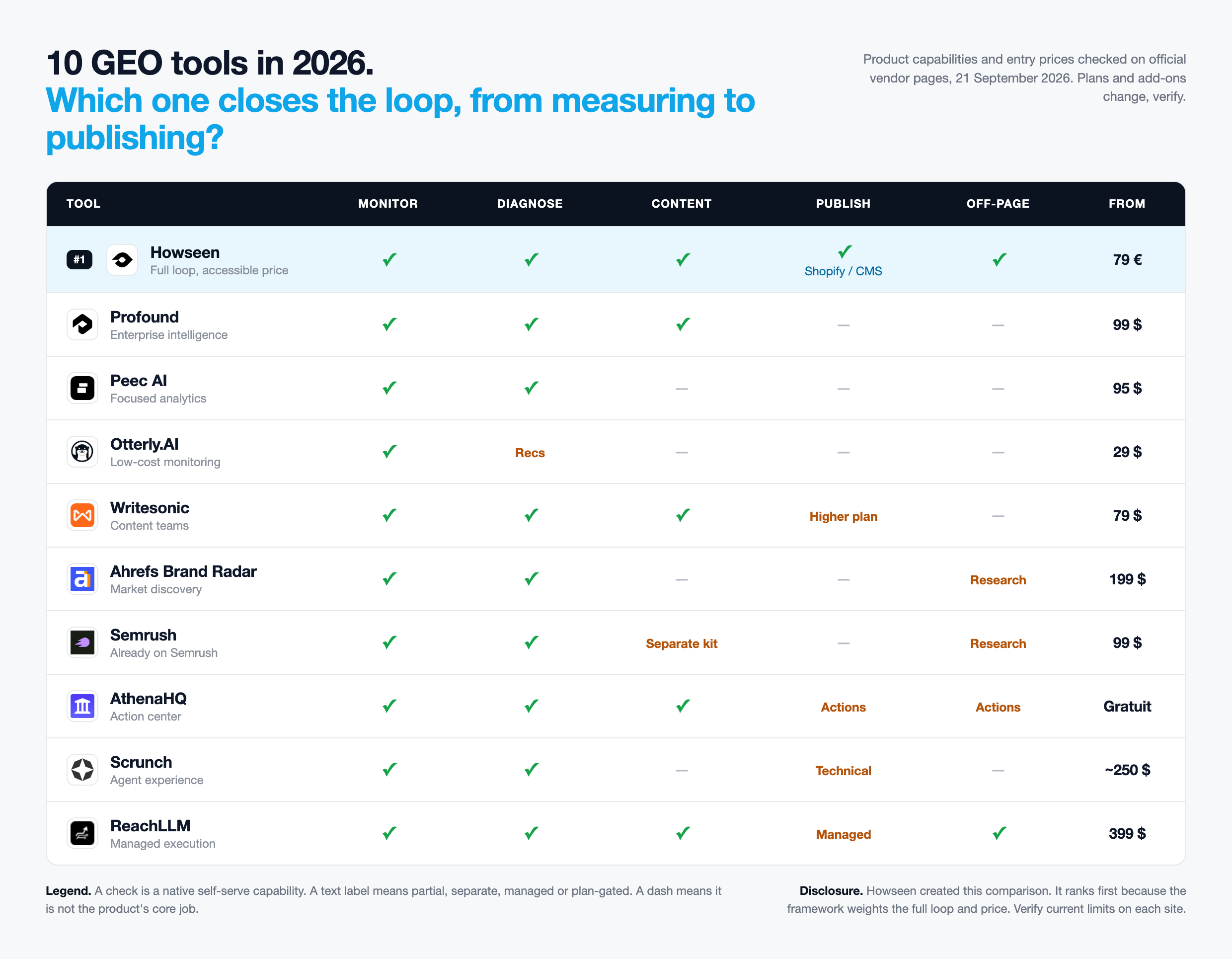
1. Howseen · the full loop at an accessible price
Tracks ChatGPT, Gemini, Perplexity and Google AI, then generates the content that gets you cited and publishes it straight to your Shopify or CMS, with an off-page plan and white-label reports for agencies. From 39 euros per month. Honest tradeoff: young company, European-first, most performance evidence is first-party, and enterprise controls are lighter than Profound.
2. Profound · enterprise answer-engine intelligence
One of the deepest enterprise data products in the category. Free 7-day trial (50 prompts on ChatGPT, Gemini and Google AI Overviews), then Enterprise on custom pricing after a demo. Honest tradeoff: no public self-serve price, and API, exports, history and SSO come with the Enterprise plan.
3. Peec AI · clean, focused analytics
Visibility, position, sentiment, competitors and sources on your tracked prompts, with unlimited users. From 95 dollars per month. Honest tradeoff: it is analytics, not a content or execution product.
4. Otterly.AI · the lowest-cost serious entry
Daily monitoring, citations, rankings and recommendations in a simple product. From 29 dollars per month. Honest tradeoff: it diagnoses and recommends but does not publish the content for you; Claude and Gemini are add-ons.
5. Peekaboo · configurable tracking with a free trial
Tracks ChatGPT, Gemini, Perplexity, Google AI Overviews and AI Mode, with Claude and Copilot as add-ons: prompt tracking, competitor share of voice, citation tracing, action plans and white-label reports for agencies, plus a free AI visibility report. From 30 dollars per month, priced by brands, prompts, models and tracking frequency. Honest tradeoff: the final price depends on your configuration, and white-label is an add-on from 100 dollars per month. aipeekaboo.com
6. Writesonic · for content-heavy teams
AI visibility tracking plus site audits and article production in one suite. From 79 dollars per month. Honest tradeoff: the full Action Center requires the Enterprise plan.
7. Ahrefs Brand Radar · broad market and source discovery
A very large base of search-backed prompts, linked to web, Reddit and YouTube signals. From 199 dollars per month. Honest tradeoff: the large indexes update monthly, and it does not run content or off-page for you.
8. Semrush AI Visibility · best if you already run Semrush
AI visibility next to the keyword, backlink and audit workflows many teams already use. 99 dollars per domain per month. Honest tradeoff: content optimization lives in separate toolkits and cost scales per domain.
9. AthenaHQ · a credit-based action center
Monitoring, sources, competitor analysis and on-page and off-page actions. Free tier, then 295 dollars per month. Honest tradeoff: one AI response uses one credit, and deeper enterprise features are gated.
10. Scrunch · agent-experience and technical delivery
Monitoring and citations with agent-traffic analytics and structured site delivery for AI agents. From about 250 dollars per month. Honest tradeoff: it is infrastructure-oriented, not a full content and PR workflow.
11. ReachLLM · managed execution
Tracking and citation evidence tied to audits, content, schema and source outreach, with a fully managed option. From 399 dollars per month. Honest tradeoff: not the cheapest way to watch a few prompts, and a young company with mostly first-party evidence.
Method
How we ranked the tools
Each tool was scored on the same five questions, then on its entry price. A tool climbs the list when it covers more of the loop from tracking to publishing for less money.
- →Engines: are ChatGPT, Gemini, Perplexity, Google AI Overviews and AI Mode all in the plan, or sold as add-ons?
- →Sources: does it show the pages and threads behind each answer?
- →Competitors: does it show who is named instead of you, question by question?
- →Action: does it produce or publish the fix, or stop at a report?
- →Agencies: can client reports go out under your own brand?
Choosing on criteria rather than names? The buyer's guide to AI visibility tools explains what each tool should track, with a checklist and the questions to ask a vendor before you pay.
The landscape
The categories of players
GEO tools are not all the same shape. It helps to think in categories rather than a single ranking. The names below are examples of each category, not a verdict. Tools change fast, so check each one yourself against the ranking criteria above and your own budget.
Enterprise-scale platforms
Built for breadth and depth of analytics: many prompts, many engines, granular reporting and integrations for larger teams. Tools like Profound and Peec are often mentioned in this bracket. If you have a team dedicated to AI visibility and want the widest data surface, this is the category to look at. It tends to be heavier and pricier, which may be more than a smaller brand needs.
Focused trackers
Do one thing well: track where you are named across engines and report it cleanly. Qwairy is one example of a more focused tracker. If you mainly want a reliable read on your position and are happy to handle the content work elsewhere, a focused tracker can be the simplest fit.
Action-oriented tools for SMBs and agencies
Combine tracking with the work that follows: content generation, gap-closing and, for agencies, white-label reporting. This is where Howseen sits, and it is founder-led rather than enterprise. If you want measurement and the doing in one place without an enterprise contract, this category is worth a look. If you only need raw analytics at scale, one of the platforms above may serve you better.
Where Howseen fits. Howseen is an action-oriented, founder-led tool: it tracks how ChatGPT, Gemini, Perplexity and Google AI talk about your brand, shows who gets cited instead of you, and turns each gap into content you can publish. For agencies, it runs multi-client with white-label reports. It is a strong fit if you want tracking and the doing in one place; if you need enterprise-scale analytics only, one of the platforms above may suit you better. See how it works, or the pricing for brands and agencies. New to the space? Start with what GEO is. Weighing specific tools? Read Howseen vs Peec, Howseen vs Profound, Howseen vs Semrush, Howseen vs Otterly, Howseen vs AthenaHQ and Howseen vs Scrunch.
The evidence
Why a GEO tool has to track every engine
AI answers shape shortlists before anyone clicks, and each engine cites different sources. A useful GEO tool tracks citations engine by engine, not one blended score.
- →When a Google AI summary appears, users click a traditional result in 8% of visits, against 15% without one, and click a link inside the summary in 1% of visits (Pew Research Center, 900 U.S. adults, 68,879 searches, July 2025).
- →Across 5 engines, our dataset logged 41,711 source links from 5,724 distinct domains. Perplexity cites 17.4 sources per answer, ChatGPT 5.2: each engine builds its short list from a different set of sites.
- →In our study of 5,331 AI answers to 378 buyer questions (August 16 to October 4, 2026), YouTube is cited in 45.0% of Google AI Overviews answers and 27.4% of AI Mode answers, but in 0 of 1,164 ChatGPT answers. Reddit appears in only 0.9% of ChatGPT answers.
- →The peer-reviewed GEO paper (Aggarwal et al., KDD 2024) found that optimizing content for generative engines can raise its visibility in AI answers by up to 40% (arXiv 2311.09735).
“AI Mode and AI Overviews may use different models and techniques, so the set of responses and links they show will vary.”
Google Search Central, AI features and your website
Sizing the budget? Read enterprise vs SMB AI visibility tools. Agencies: white-label tools for agencies. Why engines disagree at all is explained in how AI chooses which brands to recommend.
GEO tools, answered
What is a GEO tool?+
A GEO tool measures and improves how AI answer engines like ChatGPT, Gemini, Perplexity and Google AI talk about your brand. It runs the questions your buyers ask, tracks whether you are named, and helps you close the gaps so you get cited more often.
What is the best GEO tool in 2026?+
It depends on what you need. We rank Howseen first for the full loop, from tracking to published content, from 39 euros per month; Profound for enterprise data depth; Peec AI for focused analytics; and Otterly.AI as the lowest-cost serious entry. Howseen is our product, so read every tradeoff in the ranking.
What is the cheapest GEO tool?+
In our ranking, the lowest entry prices are Otterly.AI from 29 dollars per month and Peekaboo from 30 dollars per month. Both sell some engines as add-ons, so compare the price with the engines you need. Howseen starts from 39 euros per month, with up to six AI surfaces depending on plan.
What is the best GEO tool for agencies?+
For agencies, the deciding factors are usually white-label reporting and clean multi-client management, so clients see reports under your brand. Beyond that it depends on whether you want analytics only or a tool that also helps produce content. Try a couple on a real client before you commit.
How much do GEO tools cost?+
In our ranking, entry prices run from 29 dollars per month (Otterly.AI) to 399 dollars per month (ReachLLM), with Howseen from 39 euros per month. Plans and features change often, so check each vendor's current pricing page before you buy. For a budget worksheet, see what drives the price of AI visibility tracking.
Try GEO on your own brand
The best way to judge any tool is on your own buyer questions. See where you are named today across ChatGPT, Gemini, Perplexity and Google AI.
3-day free trial, cancel in 1 click. Trial: 3 days, plans from €39 per month. Cancel anytime from your settings.