Howseen data · 2026
ChatGPT Runs 1 Search in 6 in English, Even for French Brands (2026 Data)
We looked at 19,655 web searches that AI engines ran to answer non-English buyer questions. ChatGPT ran 17.1% of them in English. Across the same brands, it added a year to 36.8% of its searches.
 By Raphaël Aubry, founder of Howseen AI · Published · Data from to
3-day free trial, cancel in 1 click. Trial: 3 days, plans from €39 per month. Cancel anytime from your settings.
Summary
AI fan-out queries in 2026: the key numbers
When ChatGPT answers a question in French, about 1 of its web searches in 6 is in English, more than a third carry a year, and the brands it names change a lot from one week to the next.
AI answers analysed
59,291
6 engines, Oct 7 to Nov 5, 2026
ChatGPT searches in English
17.1%
of 17,439, non-English questions
ChatGPT searches with a year
36.8%
2025 or 2026, of 18,116
Brands still named a week later
49.2%
same question, same engine
Named without its own site cited
39.5%
of 4,086 answers naming the brand
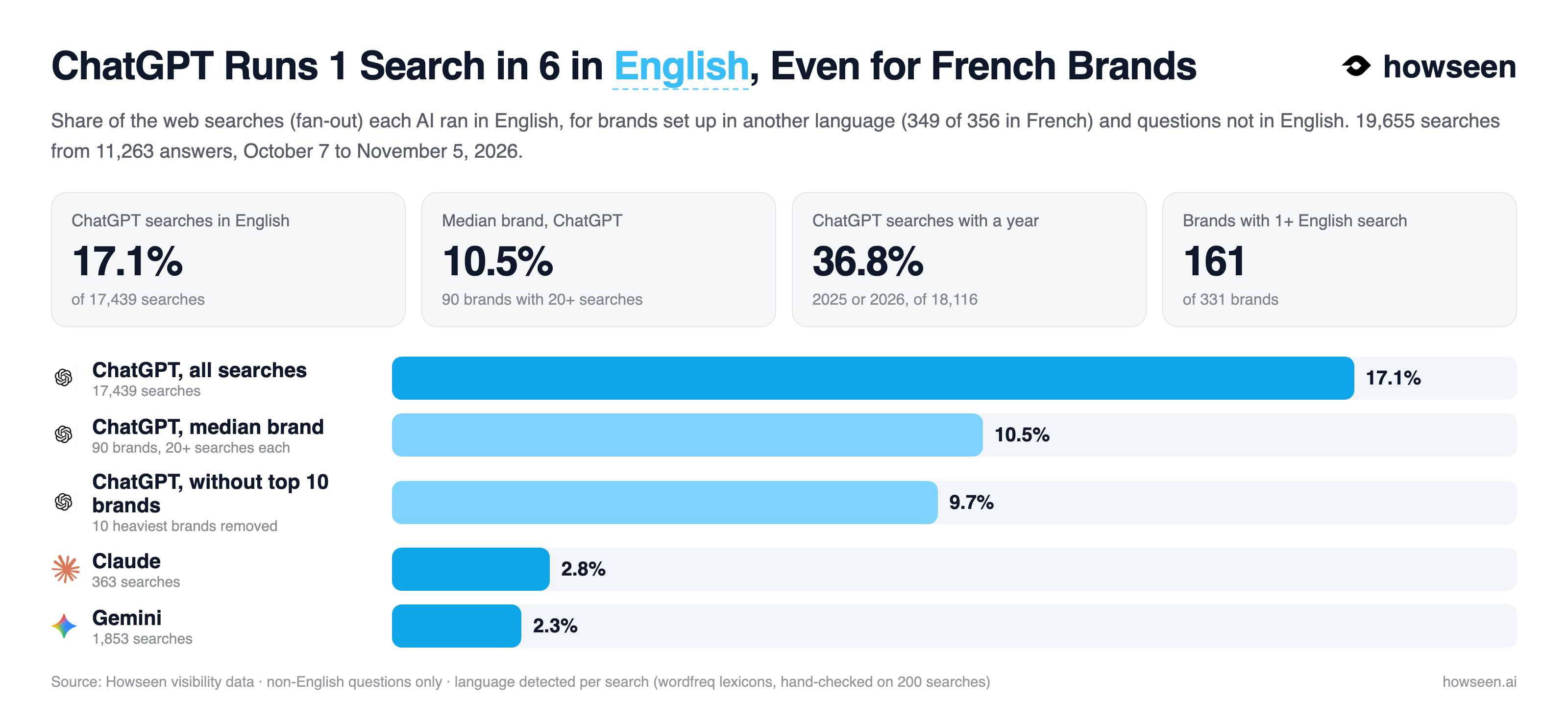
- ChatGPT switches to English often, but not for every brand. 17.1% of its searches on non-English questions were in English. For the median brand, the share is 10.5%, because 10 brands account for 58.7% of all English searches.
- Gemini and Claude stay in the question's language. 2.3% of Gemini searches and 2.8% of Claude searches were in English.
- ChatGPT dates and locates its searches. 36.8% include 2025 or 2026 and 52.1% include a country name, against 0.8% and 6.4% for Gemini.
- AI answers rotate brands. Of the brands named on a question one week, 49.2% were named again the next week on the same question and engine (recurring brand names only).
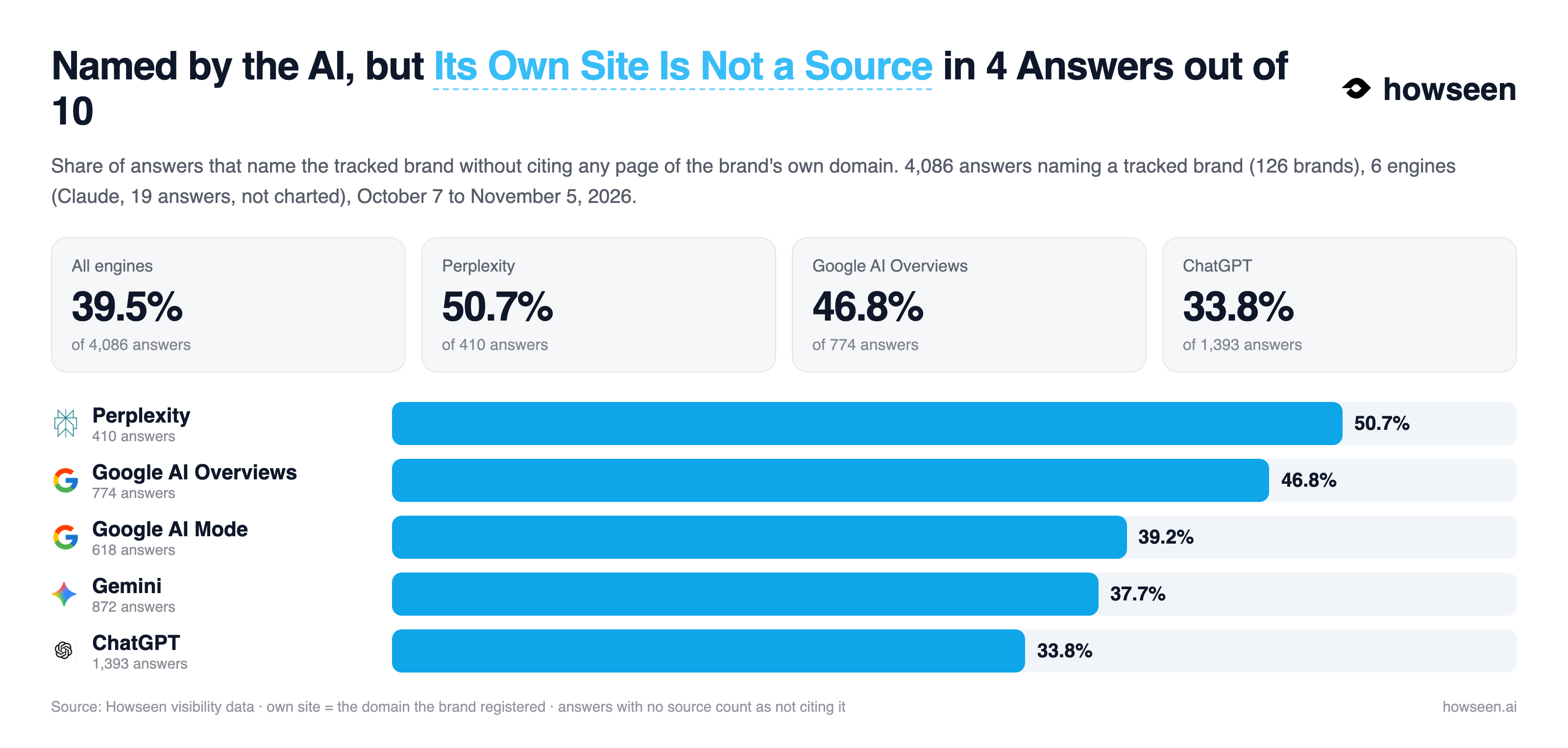
- Being named is not being cited. In 39.5% of the answers that name a tracked brand, no page of its own site is among the sources. Perplexity: 50.7%.
To answer a question, ChatGPT, Gemini and Claude first run their own web searches, often several, then write the answer from what they find. These searches are called fan-out queries. Howseen records them for every buyer question our accounts track. This study pools that data across accounts, anonymised: no brand, domain or question is shown. You can see the fan-out of any single question with our free ChatGPT query fan-out tool.
Language
Does ChatGPT search in English for non-English questions? Yes, 17.1% of the time
For questions written in French (or another non-English language), ChatGPT ran 17.1% of its 17,439 web searches in English, against 2.3% for Gemini and 2.8% for Claude.
The sample: 356 brands that set Howseen up in a language other than English (349 in French, the others in Spanish, German, Portuguese and Italian), and only the questions written in that language. ChatGPT is the engine that exposes its searches most often: we have them for 13,065 of its 13,119 answers in the period, against 642 of 13,243 for Gemini.
ChatGPT answers with 1+ English search
17.9%
of 10,559 answers
Median brand, ChatGPT
10.5%
90 brands with 20+ searches
Brands with 1+ English search
161
of 331 brands in ChatGPT
Hand-checked sample
19.0%
38 of 200 searches, 95% CI 14 to 25%
See the data
| Engine | Answers | Searches | Per answer | English | English, strict | Answers with 1+ English |
|---|---|---|---|---|---|---|
| ChatGPT | 10,559 | 17,439 | 1.65 | 17.1% | 15.6% | 17.9% |
| Gemini | 520 | 1,853 | 3.56 | 2.3% | 1.6% | 4.6% |
| Claude | 184 | 363 | 1.97 | 2.8% | 2.5% | 3.8% |
| All three | 11,263 | 19,655 | 1.75 | 15.5% | 14.1% | 17.1% |
"English, strict" also requires at least two English marker words in the search. Including questions written in English by these brands (417 answers), ChatGPT's share rises to 19.3% of 18,116 searches.
The average hides a concentration. Of the 331 brands with ChatGPT searches, 161 saw at least one in English. But the 10 brands with the most English searches account for 58.7% of them; without those 10, the share falls to 9.7%. In our hand-checked sample, English searches cluster on topics where the reference material is mostly in English: clinical evidence (dermatology, aesthetic treatments), software comparisons and official product documentation. A local service business will see far fewer.
How this compares with public observations: a panel on the French marketing podcast MVP reported 7 to 10% of fan-out searches in English. That is close to our median brand (10.5%) and to our share without the 10 heaviest brands (9.7%). The pooled figure is higher because a few sectors pull it up. Note also that a simple English word list run on the same searches gives 7.8%; the hand check below shows that this kind of list misses English searches made only of keywords.
What does ChatGPT search for your buyers' questions?
See each engine's searches, the sources it reads and whether your brand is named. 3-day free trial, cancel in 1 click.
Freshness and place
How often does ChatGPT add a year or a country to its searches?
ChatGPT added 2025 or 2026 to 36.8% of its searches and a country name to 52.1%; Gemini did so in 0.8% and 6.4% of its searches.
ChatGPT searches with 2025 or 2026
36.8%
of 18,116 searches
ChatGPT searches naming a country
52.1%
44.2% name France
Gemini searches with a year
0.8%
of 2,036 searches
| Engine | Searches | With 2025 or 2026 | With a country name | With "France" |
|---|---|---|---|---|
| ChatGPT | 18,116 | 36.8% | 52.1% | 44.2% |
| Gemini | 2,036 | 0.8% | 6.4% | 4.7% |
| Claude | 382 | 18.1% | 4.5% | 3.7% |
| All three | 20,534 | 32.9% | 46.7% | 39.5% |
ChatGPT rewrites the buyer's question into a dated, located search. In the searches we reviewed, a question about prices or the best provider typically became a keyword search ending with the buyer's country and the current year. Gemini almost never adds a year and rarely a country, so it relies on the wording of the question itself. For a brand, the practical reading is simple: the pages that answer buyer questions should state the year they are valid for and the country or region they cover, in plain text, so they match how ChatGPT searches. Our earlier analysis of how AI chooses which brands to recommend covers the other signals.
Sources
How many sources does each AI engine cite per answer?
Across 59,291 answers, AI engines cited 5.4 distinct source pages per answer on average: about 10 for Perplexity, 6.0 for ChatGPT, 4.2 for Gemini and 3.2 for Google AI Mode.
| Engine | Answers | With 1+ source | URLs per answer | Domains per answer | Median URLs |
|---|---|---|---|---|---|
| Perplexity | 10,382 | 100.0% | 9.97 | 8.25 | 10 |
| Claude | 761 | 59.9% | 7.39 | 6.61 | 9 |
| ChatGPT | 13,119 | 96.3% | 6.04 | 4.98 | 5 |
| Gemini | 13,243 | 63.8% | 4.15 | 3.98 | 4 |
| Google AI Overviews | 11,469 | 94.7% | 3.83 | 3.61 | 3 |
| Google AI Mode | 10,317 | 89.1% | 3.22 | 3.01 | 3 |
| All engines | 59,291 | 87.7% | 5.40 | 4.74 | 5 |
ChatGPT runs few searches (1.65 per answer on non-English questions) but cites about 6 pages from them, from about 5 different sites. Gemini runs more searches per answer (3.56) yet gives no source at all in 36.2% of its answers. Counted as raw links, before removing duplicates and image links, ChatGPT shows 6.83 per answer. Our study of which domains each engine cites shows that these sources also differ in kind from one engine to the next.
Stability
Do AI engines name the same brands week after week?
About half: of the brands an engine named on a question one week, 49.2% were named again the next week on the same question, and 51.0% four weeks later.
See it in real answers: who AI recommends in 10 software categories, 250 answers from ChatGPT, Gemini, Perplexity and Google AI collected on November 6, 2026.
Still named 1 week later
49.2%
21,404 brand-question pairs
Top 3 brands, 1 week later
50.6%
15,570 pairs
Still named 4 weeks later
51.0%
824 pairs, small sample
| Engine | Pairs | Named again | Top 3 pairs | Top 3 named again |
|---|---|---|---|---|
| Perplexity | 2,111 | 60.8% | 1,658 | 62.9% |
| ChatGPT | 3,090 | 51.1% | 2,078 | 50.0% |
| Claude | 604 | 49.5% | 395 | 52.4% |
| Google AI Mode | 5,068 | 48.6% | 3,786 | 50.3% |
| Google AI Overviews | 5,770 | 47.3% | 4,145 | 48.4% |
| Gemini | 4,761 | 45.8% | 3,508 | 47.8% |
| All engines | 21,404 | 49.2% | 15,570 | 50.6% |
Being in the top 3 barely protects a brand: 50.6% of top 3 brands were named again the next week, against 49.2% for all brands. Perplexity is the most stable engine (60.8%), Gemini the least (45.8%). The four-week figure (51.0%) is close to the one-week figure, which suggests a stable core of brands plus a fringe that rotates, but it rests on 824 pairs only. If every name string is counted, including names that appear once (spelling variants, product names), the one-week figure falls to 28.1% of 58,833 pairs. The practical reading: one answer, or one week, says little about a brand's position. Track the same questions over several weeks before drawing conclusions, as explained in our guide to finding the sources AI cites.
Mentions vs citations
When AI names a brand, does it cite the brand's own website?
Not always: in 39.5% of 4,086 answers that named a tracked brand, no page of the brand's own site was among the sources, and 50.7% on Perplexity.
See the data
| Engine | Answers naming the brand | Own site not cited | Among answers with sources |
|---|---|---|---|
| Perplexity | 410 | 50.7% | 50.7% (410) |
| Google AI Overviews | 774 | 46.8% | 46.0% (763) |
| Google AI Mode | 618 | 39.2% | 37.6% (603) |
| Gemini | 872 | 37.7% | 29.0% (765) |
| ChatGPT | 1,393 | 33.8% | 32.8% (1,373) |
| Claude | 19 | 21.1% | 21.1% (19) |
| All engines | 4,086 | 39.5% | 37.2% (3,933) |
In these answers, the engine knows the brand from other pages: directories, review sites, comparisons, press or forums. The same podcast panel mentioned above put this share at about half of brand citations. Our overall figure is lower (39.5%), and Perplexity alone is at that level (50.7%). Either way, for a large share of the answers that name you, what the AI says about you comes from someone else's page. Two consequences: check what those third-party pages say, and give the engine a page of your own that answers the question, so it has a reason to cite you directly.
For your brand
What to do with these numbers
Write pages that match how AI searches (year, country, plain answer), check the English sources of your niche, and measure over several weeks rather than from one answer.
- Match the search, not only the question. ChatGPT adds a year to 36.8% of its searches and a country to 52.1%. State the year and the market a page covers, in the title and the first lines.
- Look at the English sources of your niche. If your sector relies on English references (clinical studies, software reviews, technical documentation), ChatGPT may read them even for a French question. Know which ones it reads.
- Work on the pages that name you. In 39.5% of the answers that named a brand, its own site was not a source. Third-party pages carry that answer.
- Measure over time. About half the brands named one week are named again the next. Follow the same questions every week before judging a change, and compare engines separately.
This is what Howseen tracks for each brand: the searches each engine runs, the sources it reads and whether the brand is named, week after week. Plans and limits are on our pricing page; for the background, start with what generative engine optimization (GEO) is.
Check it on your own buyer questions
Run your questions through ChatGPT, Gemini, Perplexity, Claude, Google AI Overviews and AI Mode, and see what they search, what they cite and who they name. Start with a 3-day free trial.
Methodology
How we measured it, and the limits
This study covers 59,291 answers from six AI engines to 5,453 buyer questions tracked by 426 Howseen brands between October 7 and November 5, 2026.
- Data: Howseen visibility data, anonymised and pooled. Answers that returned an error and answers carried over from an earlier scan are excluded. Engines: ChatGPT, Gemini, Claude, Perplexity, Google AI Overviews and Google AI Mode.
- Fan-out searches: the web searches an engine reports running for an answer. ChatGPT reports them for almost every answer, Gemini for 4.8% of its answers in the period, Claude for part of its answers; Perplexity and Google's surfaces do not expose them in our data.
- Language detection: each search is split into words. A word counts as English if it is among 2,000 frequent words that are clearly more common in English than in French, Spanish, German, Italian or Portuguese (word frequencies from the open-source wordfreq project); it counts as non-English if it belongs to the matching lists for those languages, or carries an accented letter. A search is English when at least 60% of its marked words are English. Brand names, places and technical terms are neutral. The question itself is classified the same way, and only non-English questions are used for the main figure.
- Hand check: 200 ChatGPT searches drawn at random were labelled by hand: 38 were English (19.0%, 95% confidence interval 14.2% to 25.0%). The detector flagged 36, 35 of them correctly, and missed 3 (proper nouns with accents, French acronyms). Read the pooled ChatGPT share as roughly 15% to 19%, and keep in mind the brand-level spread.
- Year and country: a search counts if it contains "2025" or "2026", or the name of one of about 25 countries (plus Québec), written in English, French or the local language.
- Sources: distinct URLs per answer, query strings removed, image links (images.openai.com) excluded. Our collection keeps at most 25 sources per answer, and Perplexity returns about 10.
- Persistence: a scan cycle is a calendar week (Monday start). A brand is "named again" if it appears in the brands named by the same engine for the same account and question the following week. Main figures keep brand names seen in at least 20 answers over 60 days. Top 3 = the first three brands named in the answer. The four-week figure uses 60 days of history.
- Own site: the domain the brand registered with Howseen. An answer cites it if one of its sources is on that domain or a subdomain.
Limits. These are Howseen accounts, not a sample of the web: 98% of the non-English brands are French, and the sector mix of our accounts shapes the English share. Language detection is a heuristic. Brand names extracted from answers include variants, which lowers measured persistence. The comparison with the MVP podcast panel is with figures stated in a public discussion, not with a published study. Gemini's fan-out figures rest on the minority of its answers that expose their searches.
Questions, answered
What are fan-out queries?+
They are the web searches an AI engine runs on its own before writing an answer. In our data, ChatGPT ran 1.65 searches per answer on average, Claude 1.97 and Gemini 3.56, then wrote the answer from the pages it found.
Does ChatGPT search in English when you ask in French?+
Sometimes. On questions written in French or another non-English language, 17.1% of ChatGPT's 17,439 searches were in English between October 7 and November 5, 2026. For the median brand the share was 10.5%, and 10 brands in English-heavy sectors produced 58.7% of the English searches.
Do Gemini and Claude also search in English?+
Much less. Only 2.3% of Gemini's 1,853 searches and 2.8% of Claude's 363 searches on non-English questions were in English in our data.
Why does ChatGPT add the year to its searches?+
To find current pages. 36.8% of ChatGPT's searches contained 2025 or 2026, against 0.8% for Gemini. Pages that state the year they are valid for match these searches more directly.
How many sources does ChatGPT cite per answer?+
About 6: 6.04 distinct URLs from 4.98 domains on average over 13,119 answers, with at least one source in 96.3% of answers. Perplexity cited about 10, Google AI Mode 3.2.
Are the brands AI recommends stable over time?+
Partly. Of the brands named on a question one week, 49.2% were named again the next week by the same engine, and 50.6% of top 3 brands. Perplexity was the most stable at 60.8%, Gemini the least at 45.8%.
Can AI mention my brand without citing my website?+
Yes, often. In 39.5% of 4,086 answers that named a tracked brand, none of the sources was on the brand's own domain. The share was 50.7% on Perplexity and 33.8% on ChatGPT.
See what AI searches in your niche, and whether it names you
Start a 3-day free trial. Then track, engine by engine and week by week, the searches, the sources and the brands.