Product · Buyer prompts
Prompt tracking: the questions your buyers really ask AI
Your prospects do not type keywords into ChatGPT, they ask full questions. Howseen tracks those questions, one by one, and shows who AI recommends for each.
 By Raphaël Aubry, founder of Howseen AI · Updated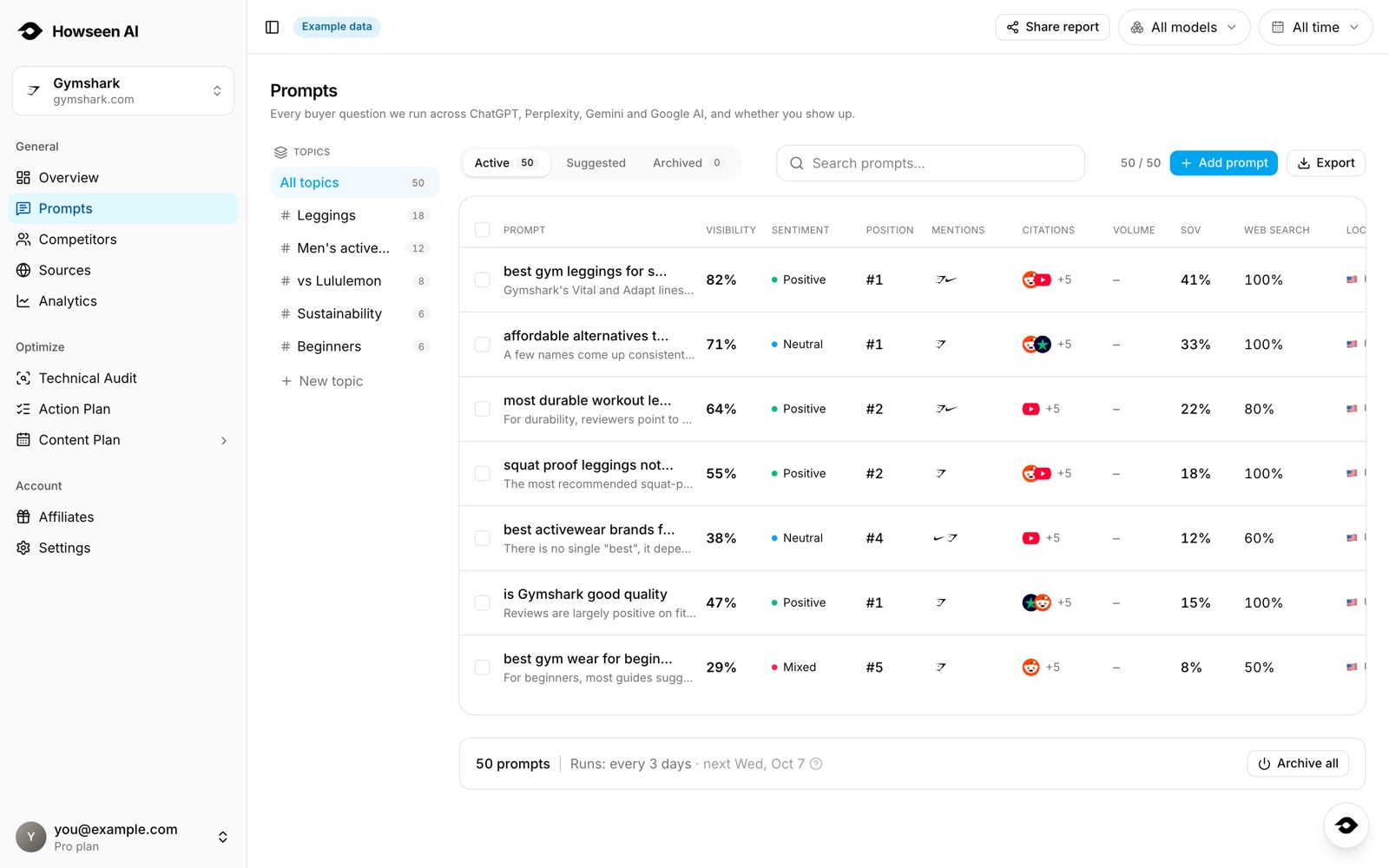
Definition
What is AI prompt tracking?
AI prompt tracking means running a fixed set of buyer questions in AI assistants on a schedule and recording, for each question, which brands are named and which sources are cited.
A prompt is the full question a buyer asks AI: “best CRM for a 10-person B2B team”, “alternatives to X that cost less”, “is X good quality”. Your visibility is only as good as the questions you measure. Track only your brand name and you will look great; track the questions buyers ask before they know you, and you see the real picture.
AI also turns one question into many searches. Google explains that both AI Overviews and AI Mode may use a query fan-out technique, issuing multiple related searches across subtopics to build a response (Google Search Central, AI features and your website). See it on one question with the free AI query fan-out tool.
“Under the hood, AI Mode uses our query fan-out technique, breaking down your question into subtopics and issuing a multitude of queries simultaneously on your behalf.”
The shift is already measurable: Gartner predicted that search engine volume would drop 25% by 2026 because of AI chatbots and virtual agents, and research on generative engines shows that the way a page answers a question changes how often it is cited (Aggarwal et al., GEO: Generative Engine Optimization, KDD 2024).
Which prompts
Which buyer prompts to track: a full-funnel mix
Track a mix of question types, from the generic category question to the direct comparison, because AI names different brands at each stage of the buying journey.
- Category: “best gym leggings for squats”. The buyer does not know you yet: the hardest and most valuable answers to win.
- Alternatives: “affordable alternatives to [leader]”. The buyer is ready to switch.
- Comparison: “[you] vs [competitor]”. AI decides between two names.
- Brand: “is [you] good quality”. AI describes you, for better or worse.
- Problem: “how to pick squat-proof leggings”. AI teaches, and names a few brands on the way.
Howseen groups your prompts by topic, so you see which part of your market you own and which one a competitor holds.
What you see
What Howseen measures for each prompt
For every prompt, Howseen shows your visibility, sentiment, position, the brands mentioned, the sources cited, your share of voice and whether the engine searched the web.
- Visibility and position on each engine, and on all engines together.
- Mentions and citations: the brands named and the sources used, with the full answer one click away.
- Topics: prompts grouped by theme (a product line, a use case, a competitor).
- Suggested prompts: new full-funnel questions for your category, never a duplicate of what you already track.
- Archive with history: stop tracking a prompt without losing its past results.
- Market: each prompt keeps its country and language, so you track the answers your buyers really get.
Our cross-account data covers 378 buyer questions tracked by 16 accounts: that is where the per-engine source numbers in our study come from.
Which of your buyers' questions name a competitor?
The 3-day free trial runs your buyer questions on every engine and shows who AI names. Cancel in 1 click.
Plans
How many prompts can you track?
Starter tracks 20 buyer prompts per brand, Pro 50 per brand, and Business 100, 200 or 300 shared by up to 3 brands.
| Starter | Pro | Business | |
|---|---|---|---|
| Price | €39/mo | €79/mo | from €219/mo |
| Buyer questions | 20 | 50 | 100 to 300, shared by 3 brands |
| AI engines | 3: ChatGPT, Gemini, AI Overviews | 5: + Perplexity, AI Mode | 5 + Claude |
| Runs | every 3 days | every 3 days | daily (Claude every 3 days) |
| Competitors per brand | 3 | 5 | 5 |
| Articles per 30 days | 4 | 15 per brand | 30 for the account |
New prompts run right away, without waiting for the next scheduled run. Prompts also drive the content plan: each article answers one tracked question. Prices on the pricing page.
Questions, answered
What is a prompt in AI search?+
The full question a person asks an AI assistant, such as “best email tool for an online store”. In AI search, prompts play the role keywords play in Google: they decide which answer, and which brands, the buyer sees.
How many prompts should I track?+
Enough to cover each stage of the buying journey for your main products: 20 is a good start for one brand, 50 covers most markets well. Starter tracks 20, Pro 50, Business 100 to 300 across 3 brands.
How do I find the prompts my buyers use?+
Start from the questions sales and support hear, then the category, alternative, comparison, brand and problem questions around them. Howseen suggests full-funnel prompts for your category, and the free query fan-out tool shows the searches AI runs behind one question.
Is there search volume for AI prompts?+
AI assistants do not publish prompt volumes. Howseen focuses on the questions your buyers ask and how AI answers them, rather than on estimated volumes.
Can I track prompts in other languages and countries?+
Yes. Each prompt keeps its market (country and language), so you see the answers buyers in that market get.
What happens when I add a new prompt?+
It runs right away on the engines of your plan, then follows the normal schedule: every 3 days, or daily on Business.
Track the questions that decide your sales
Start a 3-day free trial and track your buyers' questions on every engine.